Real example: Lehman Brothers aur Repo 105 (USA) Sources: Wikipedia (Lehman Brothers, Repo 105), NY AG (sab [[SRC]] tags mein)
1. Kahani Hook: School ki Report Card
Prabhat ke chhote bhai Chintu ki school report card aayi. Usme likha tha: "Maths: A. Science: A. Behaviour: A."
Mummy khush ho gayi. Lekin Prabhat ne report card palat ke dekhi. Peeche ek chhota sa note tha teacher ka: "Chintu ne do baar homework copy kiya hai, isliye uske marks verify kiye gaye hain. Teesri test mein usne cheating ki thi, us test ke marks include nahi kiye gaye."
Prabhat bola, "Mummy, report card ka asli matlab aage ke grades mein nahi hai. Asli matlab peeche ke note mein hai."
Yehi hai audit report ka secret. Sab log sirf ek cheez dekhte hain: "clean hai ya nahi?" Lekin asli kahani report ke andar hoti hai: opinion ka type, emphasis of matter, key audit matters, aur woh chhote notes jahan auditor chilla ke nahi, par saaf saaf likh deta hai ki kahin daal mein kala hai.
Audit report auditor ka final product hai. Mahino ka kaam, saare procedures, saara evidence, sab condense hoke ek document mein aata hai. Investor, bank, sarkar, employee, sab isi ek document ko padh ke decide karte hain ki company pe bharosa hai ya nahi.
Is chapter mein:
- Audit report ke elements (kya kya hota hai)
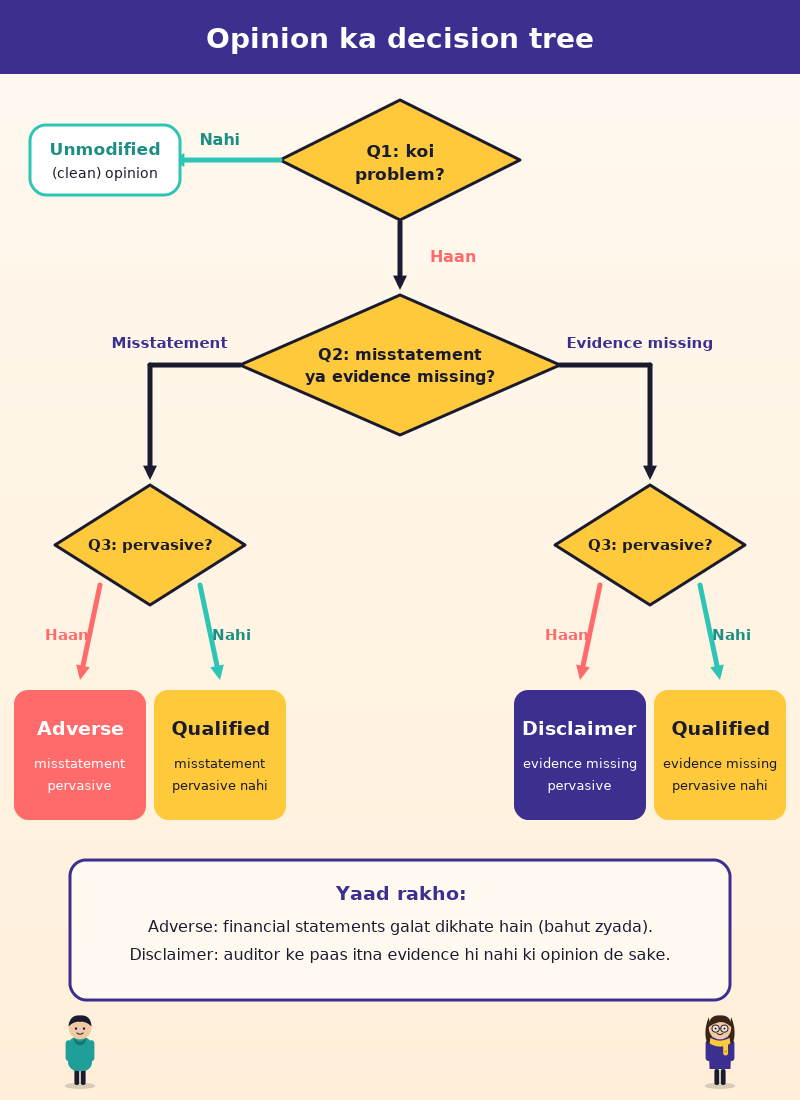
- Opinion ke 4 types: unqualified, qualified, adverse, disclaimer
- Emphasis of Matter aur Key Audit Matters
- India mein report: Companies Act Section 143, CARO
- Lehman Brothers: jahan auditor ne clean report di, aur company Repo 105 se $50 billion chhupa rahi thi
2. Chat Dialogue: Prabhat aur Iksha
Topic A: Audit report ke elements
Topic B: Opinion ke 4 types
Topic C: Emphasis of Matter aur Key Audit Matters
Topic D: India mein audit report: Section 143 aur CARO
Topic E: Jab report galat padhe: auditor ki liability
3. Core Idea in 3 Levels
6 saal ka bachha box
Socho tumne apne dost ko apna ghar dikhaya aur kaha, "Sab theek hai!" Dost ne check kiya aur ek chitthi di. Us chitthi mein ho sakta hai likha ho: "Sab theek hai" (clean). Ya "Sab theek hai, par bathroom ka nalka toota hai" (qualified). Ya "Ghar theek nahi hai" (adverse). Ya "Maine dekh hi nahi paya, tumne andar aane hi nahi diya" (disclaimer). Audit report woh chitthi hai. Auditor har company ke liye aisi chitthi likhta hai.
Normal explanation
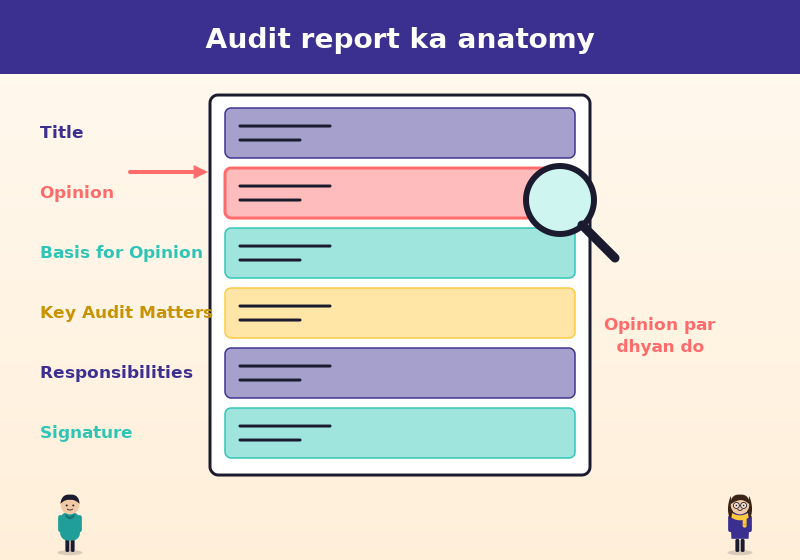
Audit report auditor ka formal opinion document hai. Structure SA 700 (Revised) deta hai: title, addressee, opinion, basis for opinion, KAM (listed entities), responsibilities, signature, date, place, UDIN in India. Opinions 4 type: unqualified (clean), qualified (except for), adverse (galat hai, pervasive), disclaimer (opinion nahi de sakte, evidence missing pervasive). Modified opinions SA 705 ke under aate hain. EOM aur KAM (SA 706, 701) opinion ko modify kiye bina reader ko important cheezein batate hain. India mein Section 143 aur CARO 2020 extra reporting lagate hain, aur Section 143(12) fraud reporting mandatory karta hai.
PhD box
Opinion formation ka logic two-dimensional hai: nature of issue (misstatement vs inability to obtain evidence) x pervasiveness (material-but-not-pervasive vs material-and-pervasive). Isi 2x2 se qualified/adverse/disclaimer nikalte hain. Pervasiveness ka judgement subjective hota hai aur hi-stakes hota hai: ek qualification se company ka cost of capital badh jaata hai, isliye auditors aur management ke beech opinion negotiation ek studied phenomenon hai. Revised auditor reporting (post-2015 IAASB changes) ne opinion ko upar laya aur KAM introduce kiya kyunki 2008 crisis ke baad criticism tha ki audit reports "binary aur information-free" hain. Research kehti hai KAM ne report ki communicative value badhayi hai, par boilerplate ho rahi hai. India mein NFRA auditor liability ko aggressive pursue karta hai: documentation quality hi defence hai (ch9 se link). Going concern reporting ka "expectation gap" persistent hai: Carillion jaise cases mein clean opinion ke 4 mahine baad collapse. Lehman mein E&Y ka stance tha ki Repo 105 accounting GAAP-compliant tha; critics kehte hain legal form pe substance dominate kiya gaya. Substance over form hi auditor ka dharma hai.
4. Real Example: Lehman Brothers aur Repo 105, $50 billion ka jaadu
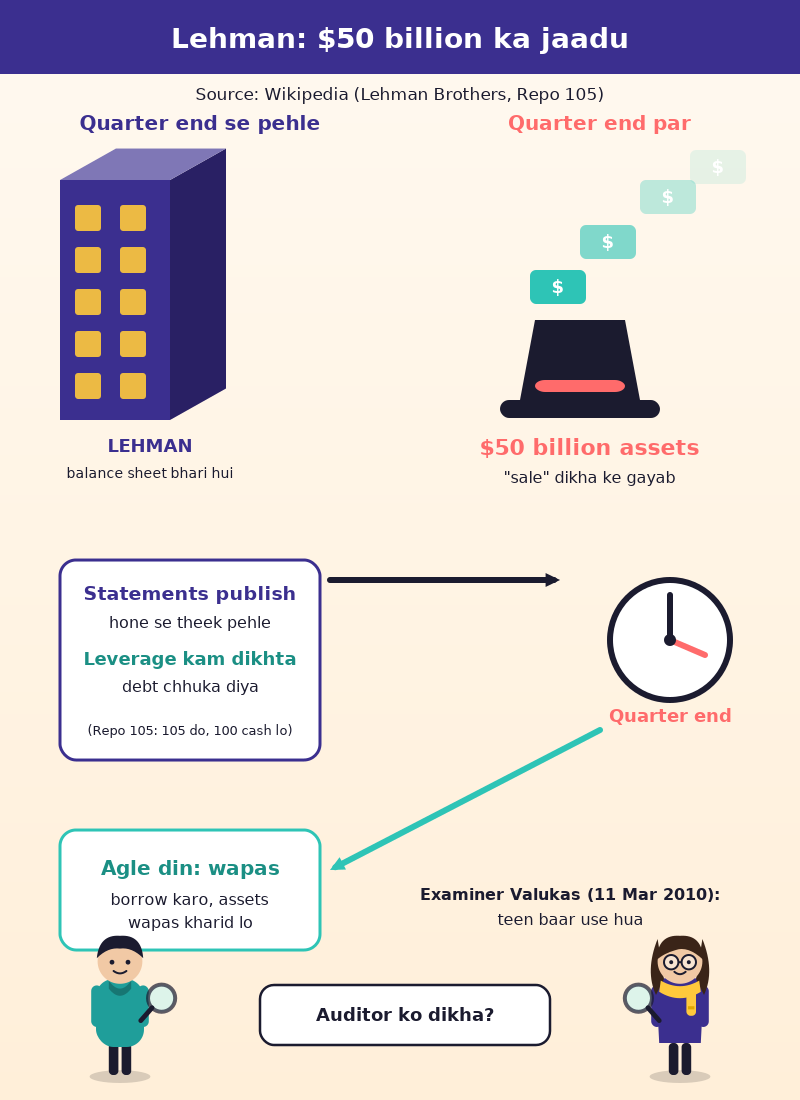
Lehman ka collapse
Lehman Brothers ek 150+ saal purani American investment bank thi. 15 September 2008 ko usne Chapter 11 bankruptcy file ki, jo US history ki sabse badi bankruptcy thi: $639 billion assets, $613 billion bank debt, aur $155 billion bond debt ke saath [src]. 2008 tak company ke $680 billion assets sirf $22.5 billion capital pe tike the, matlab leverage extreme tha [src].
Banks leverage ratio pe judge hoti hain: kitna debt, kitna equity. Lehman ko pata tha ki market uska leverage dekhti hai. Toh usne ek trick nikali.
Repo 105: balance sheet ka make-up
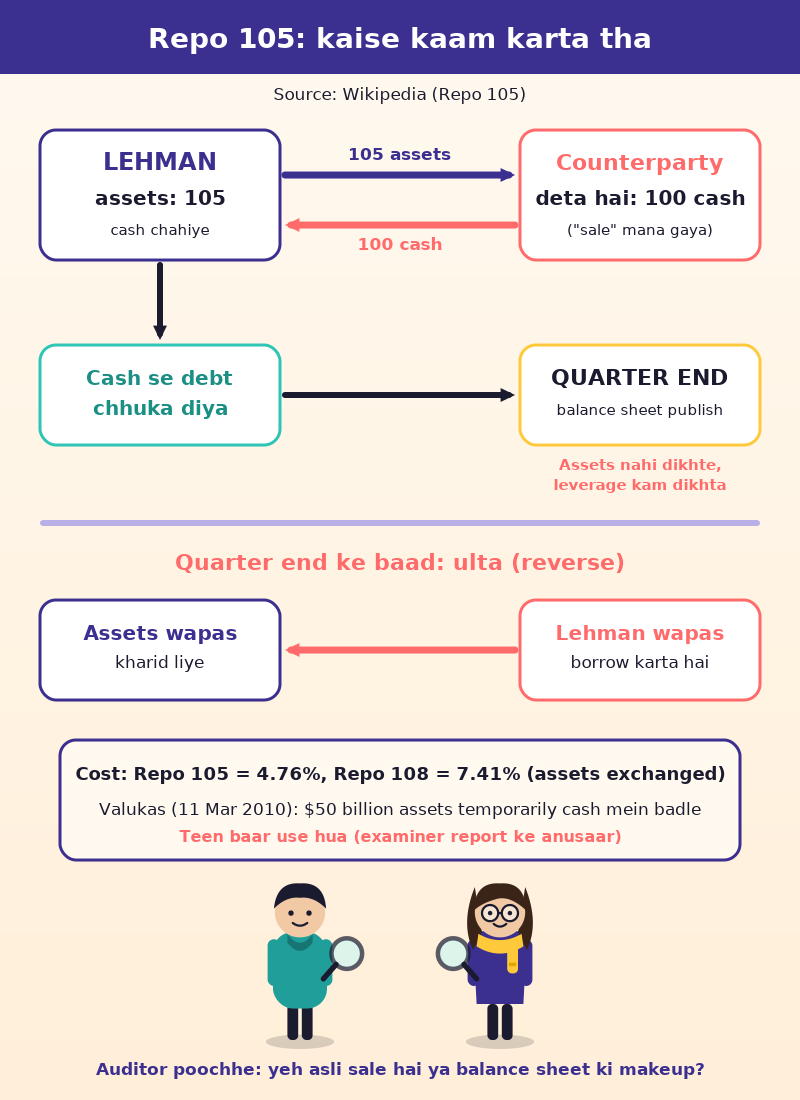
Normal repo (repurchase agreement) mein aap assets ko collateral ki tarah deke short-term cash lete ho: technically ek loan. Accounts mein bhi loan hi dikhta hai, asset balance sheet pe rehta hai, liability badhti hai.
Lehman ne kuch repo deals ko sale ki tarah treat kiya. Iska naam tha Repo 105: 105 value ki assets do, 100 cash pao (cost lagbhag 4.76%). Ek variant tha Repo 108 (108 deke 100 pao, cost 7.41%) [src]. Kyunki isko "sale" mana gaya, assets balance sheet se gayab ho jaate the aur aayi hui cash se Lehman apna debt chhuka deta tha. Result: quarter-end balance sheet pe leverage kam dikhne laga.
Court-appointed examiner Anton Valukas ki 11 March 2010 ki report ke hisaab se, Lehman ne is trick se financial statements publish karne se theek pehle $50 billion ke assets temporarily cash mein badle [src]. Report publish hote hi, company phir se borrow karti aur assets wapas kharid leti. Ye trick examiner ke hisaab se teen baar use hua [src].
Investors ko kya dikha? Ek "healthier" Lehman. Reality: wahi leverage, bas do din ke liye chhupa hua.
Auditor kahan tha?
Lehman ke auditor the Ernst & Young. Examiner ki report ke mutabik E&Y is classification se aware tha [src]. E&Y ne kabhi Lehman ke accounts qualify nahi kiye. Baad mein E&Y ka stance raha ki transactions ko GAAP ke hisaab se account kiya gaya tha [src].
December 2010 mein New York Attorney General Andrew Cuomo ne E&Y ke khilaf case kiya, alleging ki firm ne Lehman ki "massive accounting fraud" mein substantially assist kiya, aur $150 million maange [src]. Case 2015 mein $10 million mein settle hua, bina E&Y ke wrongdoing admit kiye [src].
Audit report chapter ke lessons
- Clean opinion ka matlab "risk-free" nahi. Lehman ki last reports clean the. Readers ko opinion ke peeche ki judgement samajhni chahiye.
- Substance over form. Repo 105 legally "sale" banaya gaya, par substance mein woh window-dressing loan tha. Auditor ka kaam form nahi, substance dekhna hai.
- Window dressing hi ek misstatement hai. Agar balance sheet sirf ek din ke liye achhi dikhti hai, toh woh true and fair nahi. Period-end transactions ko auditor specially test karta hai.
- Modified opinion ka power. Ek qualified ya adverse opinion 2007 mein shayad market ko jaga deta. Auditor ke paas nuclear option hota hai, par use karne mein bahut pressure hota hai (client loss, fees, relationships).
- Expectation gap. Public sochti hai audit = guarantee. Reality: reasonable assurance. Lehman ke baad hi auditor reports reform hue, KAM aaye, aur going concern disclosures strong hue.
5. Infographic Section
6. Exam Angle: UPSSSC isko kaise poochta hai
Audit report aur opinions UPSSSC ke favourite hain: opinion types, "except for" wording, CARO ka full form, Section 143 ke clauses, UDIN. Neeche 5 PYQ-style questions.
Q1. Jab financial statements mein material misstatement ho par pervasive na ho, auditor kaunsa opinion deta hai? (a) Unqualified (b) Qualified (c) Adverse (d) Disclaimer
Answer: (b). Material but not pervasive misstatement = qualified opinion ("except for"). Adverse tab jab pervasive bhi ho.
Q2. Disclaimer of opinion kab diya jaata hai? (a) Jab statements galat hon aur pervasive ho (b) Jab auditor sufficient appropriate evidence na le paye aur effect material and pervasive ho (c) Jab management rude ho (d) Jab fees na mili ho
Answer: (b). Disclaimer = evidence ki kami, material aur pervasive. Adverse = misstatement ka proof, material aur pervasive. Dono confuse mat karna.
Q3. "Except for" wali wording kis opinion mein aati hai? (a) Unqualified (b) Qualified (c) Adverse (d) Disclaimer
Answer: (b). Qualified opinion ki signature phrase hai.
Q4. CARO 2020 ka full form kya hai? (a) Companies (Audit Report) Order (b) Companies (Auditor's Report) Order (c) Company Accounts Review Order (d) Corporate Audit Reporting Order
Answer: (b). Companies (Auditor's Report) Order, 2020. 21 clauses hain isme.
Q5. Companies Act 2013 ka kaunsa section auditor dwara fraud ko Central Government ko report karne se juda hai? (a) Section 139 (b) Section 141 (c) Section 143(12) (d) Section 147
Answer: (c). Section 143(12): fraud above prescribed threshold report karna mandatory hai (ADT-4 route).
7. Recap Page
10 bullet points
- Audit report auditor ka final product hai: SA 700 (Revised) structure deta hai, opinion section ab upar aata hai.
- Opinion ke 4 types: unqualified (clean), qualified (except for), adverse (galat + pervasive), disclaimer (evidence missing + pervasive).
- Decision ka logic: nature (misstatement ya evidence gap) x pervasiveness. SA 705 modified opinions cover karta hai.
- Emphasis of Matter (SA 706): reader ka dhyan kisi disclosed cheez pe; opinion modify nahi hota.
- Key Audit Matters (SA 701): audit ke sabse significant matters, listed companies mein mandatory.
- India: Section 143(3) matters, CARO 2020 (21 clauses), internal financial controls reporting, UDIN se verification.
- Section 143(12): fraud government ko report karna mandatory hai; auditor chup nahi reh sakta.
- Audit reasonable assurance deta hai, guarantee nahi. Lekin negligence pe auditor civil, professional aur criminal liability mein aa sakta hai.
- Lehman Repo 105: $50 billion assets quarter-end pe "sale" dikha ke hata diye, leverage kam dikhaya; auditor E&Y aware tha per Valukas report (2010); NY AG case 2015 mein $10M settle.
- Report padhna ek skill hai: opinion ke saath EOM, KAM aur basis paragraph zaroor padho. Asli kahani details mein hoti hai.
Cheat-sheet table
| Opinion | Kab | Signature phrase / effect |
|---|---|---|
| Unqualified | Sab material respects mein theek | "True and fair view", clean |
| Qualified | Misstatement ya evidence gap, material par pervasive nahi | "Except for..." |
| Adverse | Misstatement material + pervasive | "Do not give true and fair view" |
| Disclaimer | Evidence gap material + pervasive | "We do not express an opinion" |
| Extra element | Kya hai | Standard |
|---|---|---|
| Basis for Opinion | Standards followed, independence | SA 700 |
| EOM | Disclosed matter pe dhyan | SA 706 |
| KAM | Audit ke sabse significant matters | SA 701 |
| CARO 2020 | 21-clause checklist report | Companies Act |
| Fraud reporting | Government ko ADT-4 | Sec 143(12) |
| UDIN | Fake report rokne ka unique number | ICAI |
| Lehman lesson | Clean report + window dressing = disaster | Valukas report |
Ye chapter Part ke end ki taraf le jaata hai: report likhna seekh liya. Ab aage Companies Act ke audit provisions (Chapter 12) mein kanoon ki detail milegi.