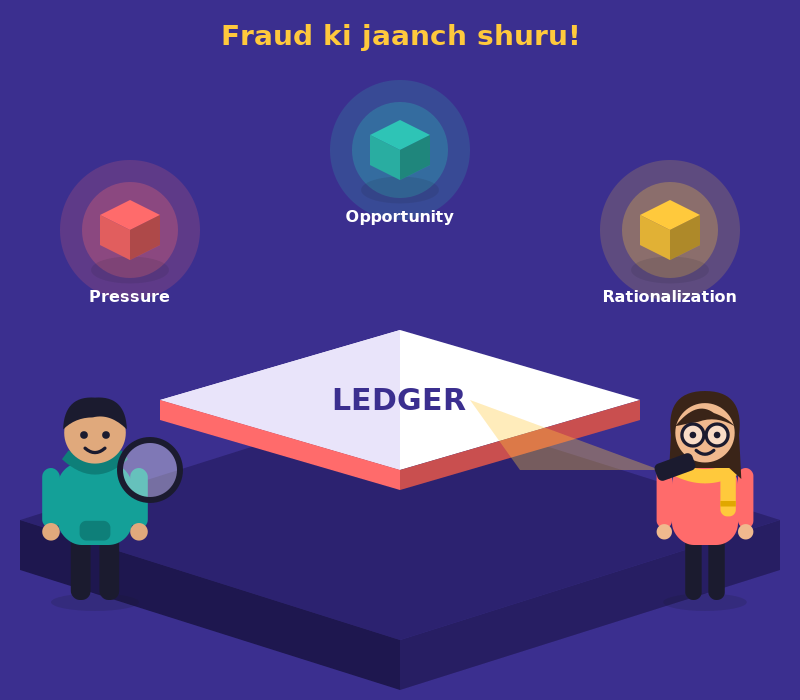
17.1 Kahani hook: Ghaayab pencil box
Prabhat ki class me ek hafte me teen baar pencil box gayab hua. Class teacher ne sabko daantne ki jagah teen sawaal puchhe:
- Kisko pencil box ki zaroorat thi? (pressure)
- Kiske paas box tak pahunch thi? (opportunity)
- Kaun khud ko samjha sakta hai ki "main to sirf udhaar le raha hoon"? (rationalization)
Jawab milte hi chor pakda gaya. Iksha hansi: "Prabhat, forensic audit bhi yehi hai. Bas pencil box ki jagah crores hote hain."
17.2 Chat: Audit aur forensic audit me fark
17.3 Core idea in 3 levels
6 saal ka bachha box Chori ke liye teen cheezein chahiye: mann karna, mauka milna, aur khud ko sahi batana. Teeno me se ek bhi hata do to chori mushkil ho jaati hai.
Normal explanation
- Fraud triangle (Donald Cressey ke kaam se jud kar jana jaata hai): Pressure, Opportunity, Rationalization. Cressey American criminologist the aur unhone embezzlement par "Other People's Money" likhi. [src] Wikipedia ke mutabik Cressey ne khud "fraud triangle" shabd nahi use kiya.
- Auditor sabse zyada opportunity ko control karta hai (internal control, Ch 6). Pressure aur rationalization dekhna mushkil hai, par signs milte hain (lifestyle, targets, attitude).
- Fraud ke teen bade prakaar (ACFE ke "occupational fraud tree" ka classification): asset misappropriation, corruption, aur fraudulent financial statements.
PhD box
- Fraud diamond (David Wolfe aur Dana Hermanson ne 2004 me, CPA Journal me): triangle me "capability" jodta hai.
- Beneish M-score: 8 ratios se earnings manipulation ki probability. Formula neeche, source tagged.
- Benford's law: natural numbers me pehla digit chhota hone ki zyada sambhavna. First digit 1 ke liye lagbhag 30.1%, kyunki P(d) = log10(1 + 1/d). Ye pure math hai, source ki zaroorat nahi, par audit use ke liye Wikipedia page dekho.
- Limits: Benford sab data par lagu nahi hota. Wikipedia ke mutabik tightly bounded data (jaise sankhya ek chhoti range me) par galat alarm aa sakta hai; election data ka misuse isi se hua. [src]
- Data-driven sampling: forensic work me full population test hota hai, sample nahi. Ye Ch 18 se judta hai.
17.4 Fraud triangle ko detail me
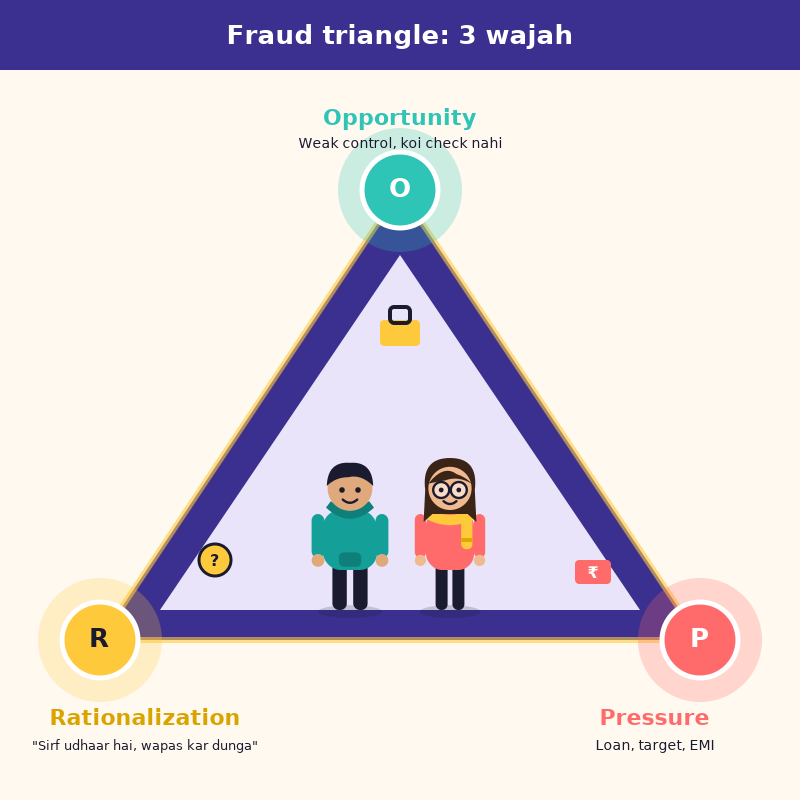
| Kona | Matlab | Examples | Auditor kya kare |
|---|---|---|---|
| Pressure (dabav) | Paise ya target ka tension | Karza, bonus target, lifestyle, gambling | Management targets padho, incentive structure samjho |
| Opportunity (mauka) | Control ki kamzori | Ek hi aadmi cash aur record dono sambhale; koi review nahi | Internal control test (Ch 6), segregation of duties |
| Rationalization (khud ko sahi batana) | "Main to chhoda hua paisa wapas kar dunga" | "Company ne mujhe kam diya", "sab karte hain" | Attitude, tone at the top, disputes with auditor |
Yaad rakhne ka trick: P-O-R (Por).
Mini kahani: Munim ji
Gupta Traders ke munim Ramesh ji cash bhi sambhalte, cash book bhi likhte, aur bank me jama bhi karte. Unke bete ki fees ka tension tha (pressure). Koi check karne wala nahi tha (opportunity). Ramesh ji ne socha, "Salary kam hai, thoda le leta hoon, Diwali pe wapas kar dunga" (rationalization). Teen saal me lakhon ka gabban. Fix: ek aadmi cash rakhe, doosra record likhe, teesra bank reconciliation kare. Isko segregation of duties kehte hain.
17.5 Red flags: kahan dhyaan dena hai
Accounting red flags
- Round figure entries (Rs 5,00,000 exactly).
- Weekend ya holiday ke journal entries.
- Month-end/year-end par badi manual entries.
- Invoice numbers me gap ya duplicate.
- Profit up, cash flow flat.
- Receivables ka tezi se badhna (DSO badhna).
- Debit/credit ek hi vendor ko baar-baar chhoti amounts jo approval limit ke neeche hain.
Behaviour red flags
- Employee kabhi chhutti nahi leta (taaki koi uska kaam na dekhe).
- Lifestyle income se zyada.
- Auditor ko documents dene me deri.
- Ek hi vyakti sab approve karta hai.
Vendor red flags
- Vendor ka address employee ke address se match.
- PO box, ya vendor jiska GST/PAN verify nahi hota.
- Ek hi bank account kai vendors ke naam.
17.6 Forensic tools: tareeke
17.6.1 Ratio / trend analysis
Pichle saalon se tulna. Revenue +40% par receivables +120%? Kuch to gadbad.
17.6.2 Beneish M-score
Formula (Wikipedia ke mutabik, 8 variables): [src]
Matlab: agar M-score -1.78 se zyada (jaise -1.2) aaye to manipulation ka risk zyada. -1.78 se kam (jaise -2.5) to kam sambhavna. [src]
Wikipedia ke mutabik Cornell ke students ne 1998 me M-score se Enron ko earnings manipulator pehchana tha, jabki Wall Street analysts tab bhi "buy" ki salah de rahe the. [src]
Sabse pehla variable DSRI (Days Sales in Receivables Index): DSRI = (Receivables_t / Sales_t) / (Receivables_t-1 / Sales_t-1)
Kalpanik (illustrative) example, asli company nahi: Pichle saal Receivables 10, Sales 100. Is saal Receivables 30, Sales 120. DSRI = (30/120) / (10/100) = 0.25 / 0.10 = 2.5. Matlab sales par receivables ka ratio 2.5 guna ho gaya. Ye red flag hai.
17.6.3 Benford's law
Pehle digit ki expected frequency (calculated, formula log10(1 + 1/d)):
| Digit | 1 | 2 | 3 | 4 | 5 | 6 | 7 | 8 | 9 |
|---|---|---|---|---|---|---|---|---|---|
| Expected % | 30.1 | 17.6 | 12.5 | 9.7 | 7.9 | 6.7 | 5.8 | 5.1 | 4.6 |
Agar invoice amounts me "9" ya "5" bahut zyada hai, ya limit ke theek neeche (jaise approval limit Rs 50,000 aur bahut saare Rs 49,900), to investigate karo.
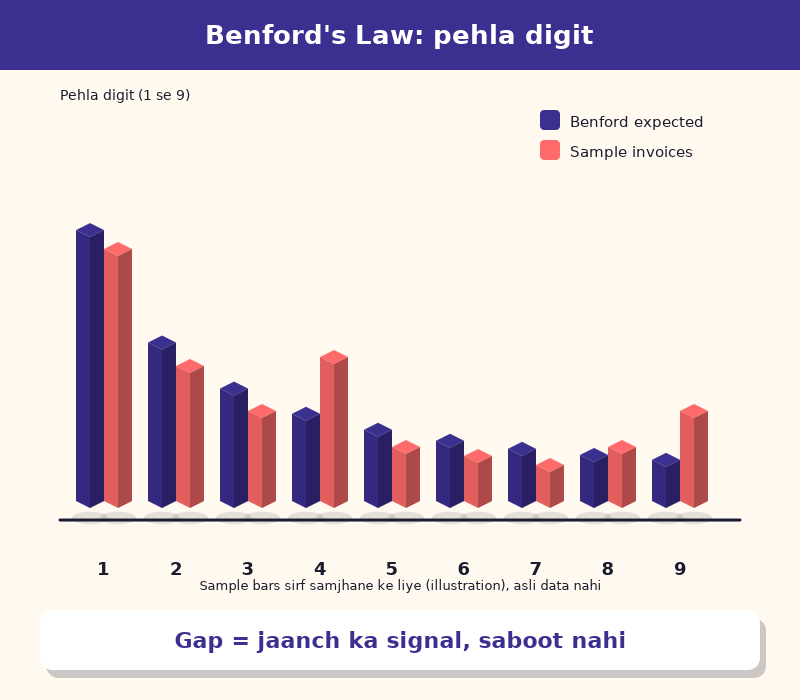
Dhyan rahe: Benford sirf signal deta hai, saboot nahi. Jab data tightly bounded ho (jaise sabhi invoices Rs 100 se Rs 200 ke beech), to ye law lagu hi nahi.
17.6.4 Duplicate aur gap testing
- Same vendor, same amount, same date: duplicate payment.
- Cheque numbers ya invoice numbers me gap: gayab documents.
17.6.5 Three-way match
Purchase Order = Goods Received Note = Invoice. Teeno match na ho to payment mat rokna, rukna chahiye.
17.6.6 Ghost employee test
Payroll list ko HR, attendance, PF aur bank details se match karo. (Satyam ka alleged ghost employee case Ch 16 me.)
17.6.7 Surprise cash count aur bank confirmation
Cash ki surprise gintee aur seedhe bank se confirmation (SA 505).
17.6.8 Lapping aur kiting
- Lapping: kal ke customer ka paisa rakh liya, aaj ke customer ka paisa kal wale ke account me jama kar diya. Chain chalti rehti hai.
- Kiting: ek bank account se doosre me cheque daal ke "float" ka faayda.
- Pakadne ka tareeka: customer ledger me payment dates aur bank deposit dates ka match, aur customers ko balance confirmation (SA 505).
17.7 Real example: Enron aur M-score ka sabak (sourced)
Ch 16 me humne dekha ki Enron ke SPE ko consolidate karne par reported earnings (1997 se mid-2001) $405 million kam hui aur karza $628 million badha. [src] Isne dikhaya ki hidden karza aur inflated profit saath chalte hain. Cornell ke students ne M-score se 1998 me hi shak jataya tha (upar sourced). Seekh: ratio-based screening ek early warning ho sakti hai, par akeli kaafi nahi. Auditor ko evidence chahiye.
17.8 Fraud ki zimmedari: Companies Act aur SA
Neeche ke points official text se verify kiye gaye (Companies (Audit and Auditors) Rules 2014 Rule 13, Section 447 text, ICAI SA list), 2026-11-27.
- Section 143(12), Companies Act 2013: agar auditor ko lage ki company ke against officers ya employees ne fraud kiya hai ya kar rahe hain, to wo report karta hai. Rule 13 (Companies (Audit and Auditors) Rules, 2014): fraud Rs 1 crore ya usse zyada ka ho to auditor 2 din ke andar Board ya Audit Committee ko batata hai (45 din me reply maangta hai), phir 15 din ke andar Central Government ko report bhejta hai (Form ADT-4, electronically). Rs 1 crore se kam ke liye auditor 2 din ke andar Audit Committee ya Board ko report karta hai, aur company Board's Report me uski details batati hai. [src]
- Section 447: fraud ki saza. Kam se kam 6 mahine, zyada se zyada 10 saal ki jail, aur fine jo fraud ki amount se kam nahi, par amount ka 3 guna tak ho sakta hai. Agar fraud public interest se jura ho to jail kam se kam 3 saal. Chhoti fraud (Rs 10 lakh ya company turnover ka 1% me se jo kam ho, usse kam, aur public interest nahi) me 5 saal tak jail ya Rs 50 lakh tak fine ya dono. [src]
- SA 240: fraud me auditor ki zimmedari. SA 315 (Revised): risk identification. SA 330: assessed risks par response. SA 505: external confirmations. SA 550: related parties. SA 580: written representations. SA 250: laws aur regulations ka compliance. [src]
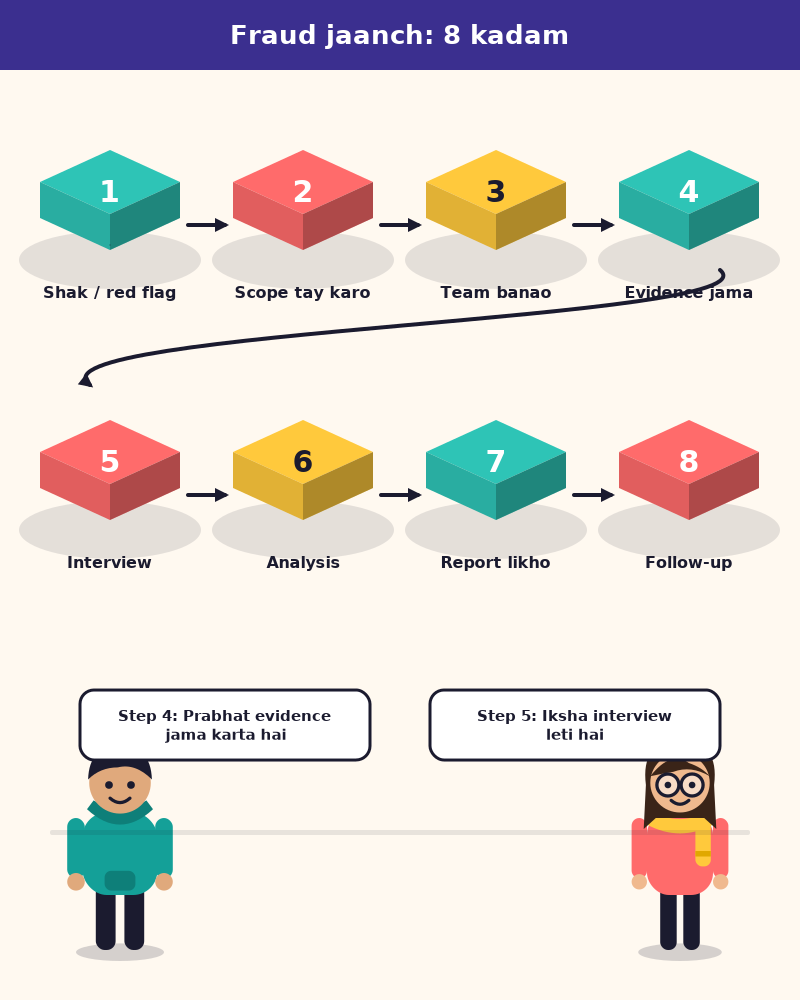
17.9 Forensic investigation ke steps (flow)
- Shak/allegation milna (whistleblower, red flag).
- Scope tay karna aur authority lena.
- Evidence secure karna (emails, ledgers, devices ki copy; chain of custody).
- Analysis (data analytics, interviews, document review).
- Interview: pehle chhote logon se, anth me suspect se.
- Quantify: kitna nuksan.
- Report: tathya (facts), kaise, kitna, kisne, aur recommendations.
- Follow-up: kanooni karyavahi aur control sudhar.
17.10 Interview ke niyam (simple)
- Pehle open sawaal: "Process batao."
- Phir specific sawaal.
- Dhamki ya laalach nahi.
- Likhit record aur do log maujood.
- Jhooth pakda jaye to turant mat bhidho, details note karo.
17.11 Prevention: fraud hone se pehle
- Segregation of duties.
- Mandatory leave aur job rotation.
- Whistleblower hotline.
- Surprise audits.
- Approval limits aur dual authorisation.
- Tone at the top: ethics code, sakht kaarvai.
- Background check hiring ke time.
17.12 Exam angle: 5 PYQ-style questions
Q1. Fraud triangle ke teen elements me kaun shamil NAHI hai? (a) Pressure (b) Opportunity (c) Rationalization (d) Audit fee. Ans: (d).
Q2. Ek hi karmchari cash bhi sambhale aur cash book bhi likhe, ye kis kamzori ko dikhata hai? (a) Pressure (b) Segregation of duties ki kami (c) Overstatement (d) Going concern. Ans: (b).
Q3. Lapping kya hai? (a) Bank charges ka hisab (b) Ek customer ka paisa rakh kar doosre customer ke paise se uska account chhupana (c) Stock ki valuation (d) Depreciation method. Ans: (b).
Q4. Benford's law ke mutabik pehla digit "1" ki expected frequency lagbhag kitni hai? (a) 11% (b) 30% (c) 50% (d) 9%. Ans: (b) 30.1% (log10(2)).
Q5. Three-way match me kaun se teen documents milaye jaate hain? (a) PO, GRN, Invoice (b) Bank statement, cash book, ledger (c) Balance sheet, P&L, cash flow (d) Voucher, receipt, journal. Ans: (a).
17.13 Recap page
- Forensic audit: fraud ka kisne, kaise, kitna, aur court me saboot.
- Fraud triangle: Pressure, Opportunity, Rationalization.
- Auditor sabse zyada Opportunity ko control se rokne me madad karta hai.
- Chain of custody: saboot ka poora record.
- M-score: 8 ratios, threshold -1.78 (sourced), -1.78 se upar = zyada risk.
- Benford's law: pehle digit 1 lagbhag 30.1%; tightly bounded data par lagu nahi.
- Duplicate, gap, three-way match, ghost employee tests.
- Lapping aur kiting: purane fraud ke classic tareeke.
- Section 143(12) aur SA 240 fraud reporting ke liye.
- Prevention: segregation of duties, mandatory leave, hotline.
| Tool | Kya pakdta hai | Limit |
|---|---|---|
| M-score | Earnings manipulation | Sirf signal |
| Benford | Banaye hue numbers | Bounded data par fail |
| Three-way match | Fake purchases | Collusion me fail |
| Surprise count | Cash chori | Snapshot hai |
| Bank confirmation | Fake cash | Collusion me fail |
Fact-check 2026-11-27: Fraud diamond authorship (Wolfe and Hermanson 2004), ACFE taxonomy, Section 143(12)/447 and SA numbers verified; see checks/ch17.md.