1. Kahani hook: Prabhat ki teen dukaan
Prabhat ke papa ki Maharajganj mein ek kirana dukaan hai. Ek din Prabhat ne socha: "Audit ek hi cheez hogi na?" Iksha ne use ek kahani sunayi.
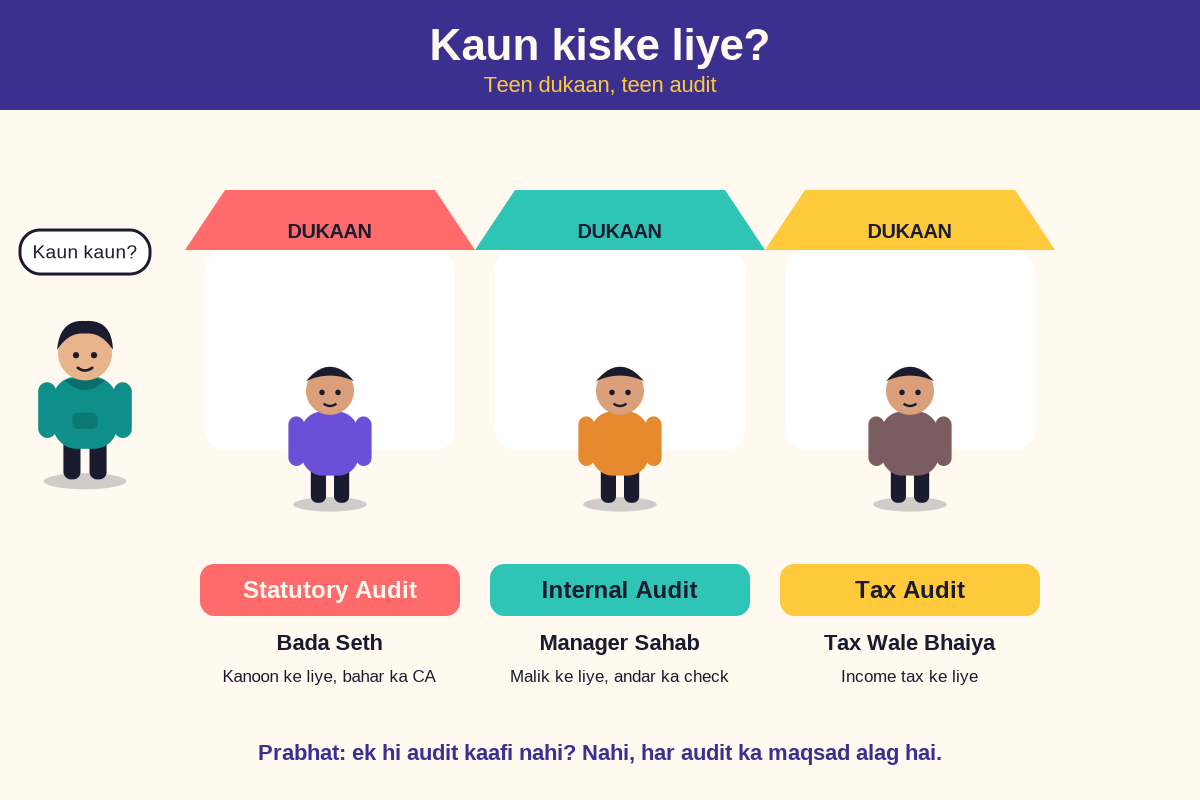
Ek gaon mein teen log aaye. Pehla aadmi bola, "Mujhe bank loan chahiye, meri kitaabein kaun check karega?" Doosra bola, "Mere godown se roz maal gayab ho raha hai, andar ka koi dekhe." Teesra bola, "Sarkar ne paisa diya hai, kya sahi jagah laga?"
Teeno ko "audit" chahiye tha. Par teeno ka audit alag tha: pehla statutory audit, doosra internal audit, teesra government audit. Jaise bimaar hone par heart doctor, dant doctor aur aankh doctor alag hote hain, waise audit bhi alag-alag kaam ke liye alag hota hai.
2. Chat dialogue
3. Core idea in 3 levels
Box 1: 6 saal ka bachha
Socho class mein teacher tumhari copy check karta hai. Wahi "statutory audit" hai: bahar ka insaan aake dekhta hai ki tumne sahi likha ya nahi. Aur jab tum khud apni copy raat ko dobara padh lete ho, wo "internal audit" hai.
Box 2: Normal explanation
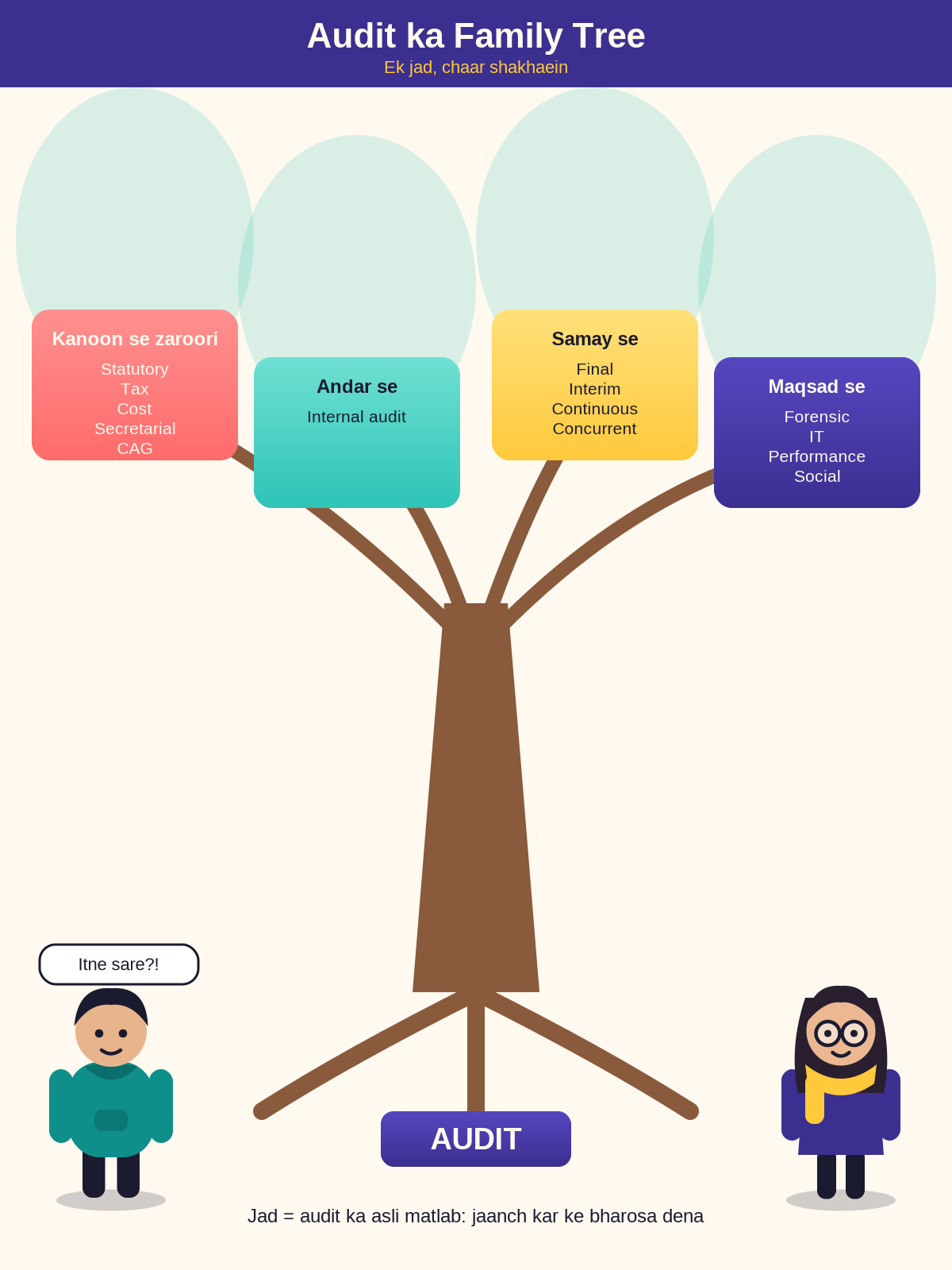
Audit ko hum 4 tarah se baant sakte hain.
A. Kanoon se zaroori ya nahi
| Type | Kanoon se zaroori? | Kaun karta hai | Kiske liye |
|---|---|---|---|
| Statutory audit | Haan (Companies Act, 2013: dhara 139 appointment, 141 eligibility, 143 powers aur duties; kuch aur kanoon bhi) | Chartered Accountant (CA firm) | Shareholders / members |
| Tax audit | Haan, Income-tax Act ke tahat limit paar karne par | CA | Tax department |
| Cost audit | Haan, notified companies ke liye (dhara 148) | Cost Accountant | Management / Government |
| Secretarial audit | Haan, bade aur listed companies ke liye (dhara 204) | Company Secretary in practice | Members / board |
| Internal audit | Dhara 138 ke tahat kuch companies ke liye zaroori | CA / CMA / staff / firm | Management, Audit Committee |
| Government (CAG) audit | Haan, Constitution aur CAG Act ke tahat | CAG ka department | Parliament / Legislature |
| Voluntary audit | Nahi, apni marzi se (jaise partnership firm, trust ya chhoti dukaan) | CA | Owner, bank, investor |
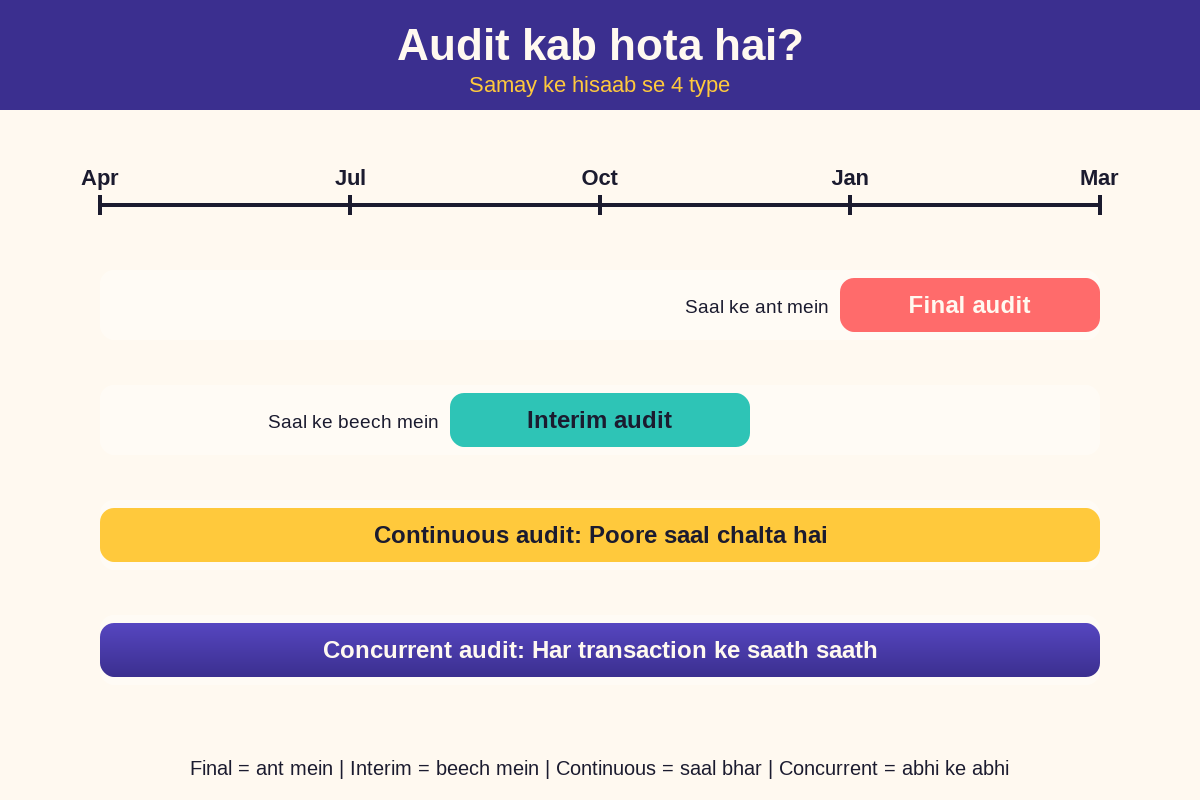
B. Samay ke hisaab se
- Final audit: saal khatam hone ke baad poora audit.
- Interim audit: saal ke beech mein, jaise half-yearly.
- Continuous audit: saal bhar thoda-thoda, auditor baar-baar aata hai.
- Concurrent audit: transaction hote hi ya turant uske baad (bank mein common).
C. Kaam ke daayre (scope) ke hisaab se
- Complete audit: poore records.
- Partial audit: sirf kuch hissa, jaise sirf cash.
- Test check: sample lekar jaanch (Chapter 8).
D. Alag maqsad wale audit
- Management audit: management ki efficiency kaisi hai.
- Performance / Value-for-money audit: economy, efficiency, effectiveness (3E).
- Propriety audit: kharcha uchit tha ya nahi, sirf kanooni hona kaafi nahi.
- Forensic audit: fraud dhoondhna (Chapter 17).
- IT audit: systems aur data ki jaanch (Chapter 18).
- Social audit: samaj par kaam ka asar (jaise gaon ki yojanaon ka public verification).
Box 3: PhD box
- Assurance spectrum: Reasonable assurance (statutory audit, positive opinion) versus limited assurance (review, jaise quarterly limited review, negative-form conclusion). Audit koi guarantee nahi deta; yeh high but not absolute level of assurance hai. Isi liye audit ke inherent limitations hote hain (judgment, sampling, collusion, management override).
- Statutory audit ka framework: Standards on Auditing (SA) dhara 143(10) ke tahat specify hote hain. Infosys ka FY2025 auditor ki report khud likhti hai ki audit SA ke mutabik hua aur ICAI ke Code of Ethics ke tahat independence hai (dekhein Section 4).
- Internal vs external theory: Internal audit ka reporting line agar CFO ke neeche hai toh objectivity kamzor hoti hai; best practice mein Audit Committee ko functional reporting hoti hai. Yeh IIA ke "three lines" model se judta hai (operations, risk/compliance, internal audit).
- Edge case: Ek hi firm statutory aur internal audit dono nahi kar sakti. Companies Act dhara 144 ke tahat statutory auditor ko kuch services dene par roka gaya hai, jinme internal audit shaamil hai (Chapter 4 mein detail).
- Joint audit: Kuch badi companies mein do ya zyada auditors milke ek report dete hain. Joint audit ka standard SA 299 (Joint Audit of Financial Statements) hai, jisme auditors ke beech kaam aur responsibility ka batwara aata hai.
- Audit of group: Parent company ka auditor subsidiaries ke auditors par rely karta hai (SA 600 ke tahat).
4. Real example: Tata Consultancy Services (TCS) ka statutory auditor badalna
TCS ek listed company hai, aur listed company ke auditor ko ek hi firm hamesha nahi rakh sakte. Yeh rotation ka kanoon hai.
- 28 February 2026 ko TCS ne stock exchanges ko batayi ki BSR & Co. LLP, ICAI Firm Registration No. 101248W/W-100022, apne doosre term ke baad 2027 ke 32nd AGM ke ant tak statutory auditor rahenge. [src]
- Board ne sifarish ki hai ki Walker Chandiok & Co LLP, ICAI Firm Registration No. 001076N/N500013, 5 saal ke liye agle auditor banein: 32nd AGM (2027) se 37th AGM (2032) tak, members ki manzoori ke baad. [src]
- Dhyaan do: sifarish Audit Committee ki hai, phir Board ki, phir members ki manzoori. Yeh poora raasta statutory audit ki independence ke liye hai.
Sabak: Statutory audit sirf "hisaab check karna" nahi, ek poora governance system hai: appointment, term, rotation, report. (Companies Act dhara 139(2): listed companies mein audit firm ko 5 saal ke zyada se zyada 2 consecutive term mil sakte hain, aur individual auditor ko sirf 1 term. Term poora hone par 5 saal ka cooling-off period lagta hai.)
Infosys ka audit report: Infosys ke FY2025 consolidated financial statements ki auditor ki report mein opinion yeh hai ki statements Companies Act, 2013 ke hisaab se "true and fair view" dete hain, Ind AS ke mutabik, 31 March 2025 ki sthiti par. Report mein Key Audit Matters bhi hain; revenue recognition (percentage-of-completion method) ek aisa KAM tha. [src]
5. Infographic / diagram
6. Exam angle
UPSSSC aam taur par definition, "kaunsa audit kisne karna hai", aur "kya sahi/galat" format mein sawaal puchta hai. Yaad rakho: Statutory = kanoon + members; Internal = management; CAG = Parliament.
Q1. Kaunsa audit Companies Act, 2013 ke tahat zaroori hai aur members ke liye hota hai? (a) Internal (b) Statutory (c) Management (d) Voluntary Ans: (b) Statutory audit.
Q2. Internal audit ka mukhya maqsad kya hai? (a) Tax bachana (b) Shareholders ko report dena (c) Management ko process aur control sudharne mein madad (d) Government ko report dena Ans: (c)
Q3. Lagaataar saal bhar thoda-thoda hone wale audit ko kya kehte hain? (a) Final (b) Interim (c) Continuous (d) Partial Ans: (c) Continuous audit.
Q4. Cost audit kis dhara ke andar aata hai (Companies Act, 2013)? (a) 139 (b) 143 (c) 148 (d) 204 Ans: (c) 148.
Q5. Value-for-money audit mein "3E" kya hain? Ans: Economy, Efficiency, Effectiveness.
7. Recap page
10 bullets
- Audit ek type ka nahi hota, maqsad ke hisaab se kai type hote hain.
- Statutory audit kanoon se zaroori hai, members ke liye hota hai.
- Internal audit management ke liye hota hai, process aur control par.
- Cost audit (dhara 148) cost records ke liye, Cost Accountant karta hai.
- Secretarial audit (dhara 204) compliance ke liye, Company Secretary karta hai.
- CAG audit Parliament/Legislature ke liye hota hai, sarkari paise ka.
- Final, interim, continuous, concurrent samay ke hisaab se type hain.
- Complete, partial, test check scope ke hisaab se type hain.
- Audit reasonable assurance deta hai, guarantee nahi.
- Listed company mein auditor rotation hota hai; TCS ka BSR se Walker Chandiok ki taraf proposal iska live example hai.
Cheat-sheet
| Audit | Kaun karta hai | Kisko report | Dhara / source |
|---|---|---|---|
| Statutory | CA firm | Members | Companies Act, 2013 |
| Internal | Staff ya firm | Management / Audit Committee | Dhara 138 |
| Cost | Cost Accountant | Board / Govt | Dhara 148 |
| Secretarial | Company Secretary | Members | Dhara 204 |
| CAG | CAG dept | Parliament | Constitution / CAG Act |
| Tax | CA | Tax dept | Income-tax Act |